Local business guide
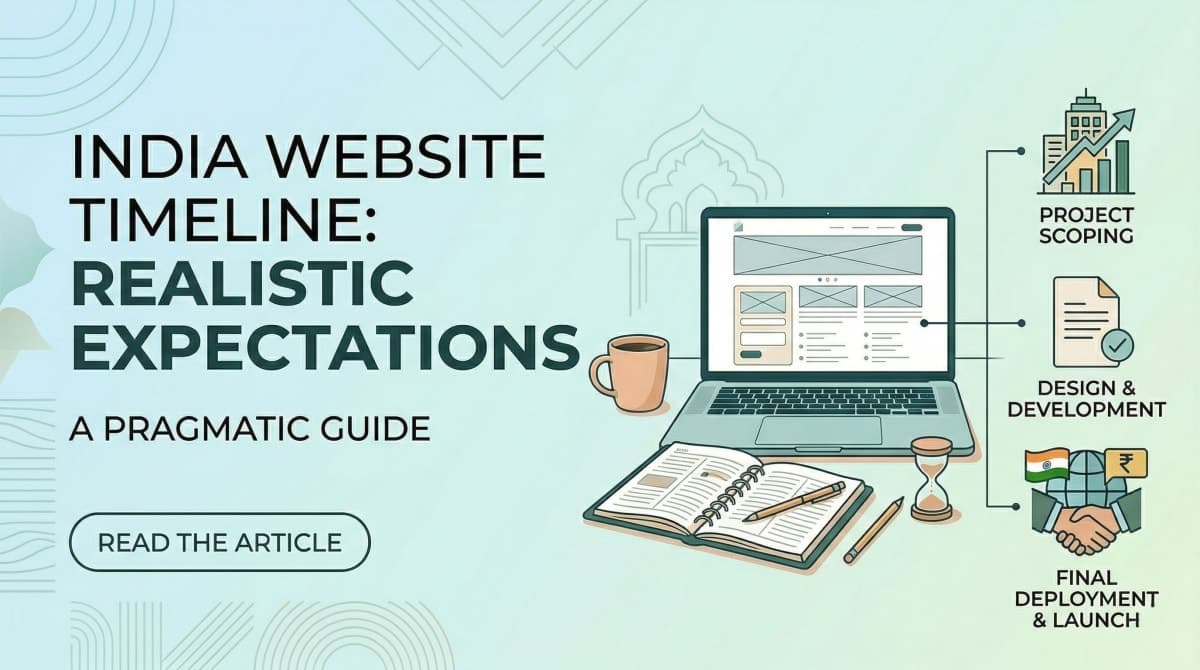
Website Development Timeline in India: Realistic Expectations
Got a developer saying "3 days" and another quoting "3 months" for the same website? Both answers are wrong - and believing either one costs you time and money.
Got a developer saying "3 days" and another quoting "3 months" for the same website? Both answers are wrong - and believing either one costs you time and money.
People read but don’t call, message, or book anything.
Visitors are confused about what to do after reading your site.
Your message is not clear in the first few seconds.
No proof, testimonials, or credibility to build confidence.
Got a developer saying "3 days" and another quoting "3 months" for the same website? Both answers are wrong - and believing either one costs you time and money.
The honest answer: a standard 5-page business website takes 2-3 weeks. But 80% of delays are caused by the client, not the developer. Understanding realistic timelines and costs helps you plan properly before starting any web project.
| Website Type | Realistic Timeline | What Affects Speed |
|---|---|---|
| Basic 3-5 page site | 5-10 working days | Content readiness |
| Business website with blog | 10-21 working days | Design revisions, content |
| Ecommerce (under 100 products) | 3-5 weeks | Product photos, payment setup |
| Ecommerce (100-500 products) | 5-8 weeks | Bulk product upload, integrations |
| Custom web application | 8-16 weeks | Feature complexity, testing |
| Large portal or marketplace | 3-6 months | Architecture, multiple integrations |
Important note: "Working days" means active development days - not calendar days. A 10-working-day project is typically 2-3 calendar weeks when accounting for weekends, client feedback rounds, and content delays.
Contextual Next Step
If this topic matters for your business, the next useful page is usually the main landing page for that intent. That gives you the service structure, proof path, and pricing context directly instead of leaving everything inside blog content alone.
Phase 1 - Discovery and Planning (1-3 days)
The developer understands your requirements, defines the sitemap (page list), collects reference websites you like, and sets the technology and design direction. This is also when you confirm payment terms and timeline.
Phase 2 - Design (2-7 days)
The visual design of your homepage and key pages is created. This is where you see how your website will look before any development begins. Expect 1-2 revision rounds. Approving design quickly here is the single biggest speed lever in the entire project.
Phase 3 - Development (5-15 days)
Once design is approved, development begins. Each page is coded, content is added, forms are connected, and integrations (WhatsApp, Google Maps, payment gateway) are set up.
Phase 4 - Review, Testing, and Launch (2-4 days)
You review the complete website on a staging link. Final feedback is addressed. The website is tested on mobile, tablet, and desktop. Domain is pointed and the site goes live.
Before
After
Understand what your website actually needs before you spend more money.
Direct team. Clear next step.
Based on my experience, 80% of project delays are caused by the client, not the developer. Here are the most common:
1. Content not ready: The developer is waiting for photos, service descriptions, pricing, or your logo. No content = no progress. Prepare all your content before the project starts.
2. Slow design approvals: "I'll look at it over the weekend" adds days to every feedback round. Commit to reviewing designs within 24 hours of receiving them.
3. Scope creep: "Can we also add a chatbot, an online booking system, and a Hindi version?" after the project has started. New features mid-project extend timelines. Define your requirements completely before signing.
4. Missing credentials: Domain access, hosting login, email account details - these are often needed urgently and cause days of delay when unavailable.
5. Multiple decision-makers: Projects involving committee approval or multiple stakeholders ("I need to show it to my partner / boss / family") consistently take 2-3x longer than single-decision-maker projects.
The clients whose projects are completed fastest all do the same things:
1. Prepare content before the project starts: Photos, logo, services list, pricing, and your business description - all ready on day one.
2. Give one-person approval authority: Designate a single person who has the final say on design and content. No committees.
3. Respond within 24 hours: Review designs, answer questions, and approve milestones the same day you receive them.
4. Define requirements completely upfront: Know what pages you want before the project starts. "I'll think about it as we go" doubles the timeline.
5. Trust the developer's judgment: Constant micro-revisions ("make the logo 2px bigger," "change this shade slightly") add hours to every iteration. Give directional feedback ("this feels too formal, I want it warmer") rather than pixel-level instructions.
Technically yes - a basic 3-page website can be built in 2-3 days if content is ready and the client approves instantly. In practice, this kind of rush is only sensible for genuinely simple websites where the stakes are low.
For any website that's meant to rank on Google, generate leads, and represent your business professionally - rushing creates problems. Design shortcuts, skipped testing, and missed SEO setup all hurt performance months later.
My recommendation: plan for 2-3 weeks. Use that time to prepare good content and photos. A properly built website that takes 3 weeks outperforms a rushed website delivered in 3 days - for the entire lifetime of the website.
Yes and I recommend it. A simple coming soon page with your contact details and WhatsApp button means your domain is active and you can share it while development continues. It also tells Google to start crawling your domain earlier.
Logo (PNG with transparent background), business description (5-8 sentences), services list with descriptions, pricing (or ranges), 10-20 photos of your work/products/premises, team photos, and contact details (phone, WhatsApp, email, address, hours).
Smartphone photos taken in good natural light work for a starting website. Avoid dark, blurry, or small images. I can also use high-quality stock photos relevant to your industry as placeholders while you arrange your own photos.
Standard practice: 2-3 rounds of design revisions and 1-2 rounds of content/development revisions. Revisions mean adjustments to the existing design - not complete redesigns. Additional revision rounds beyond the standard are billed at an hourly rate.
I submit your website to Google Search Console, set up Google Analytics, and provide a handover call explaining how to use your website and make basic updates. 3 months of free support is included for any bugs or minor changes after launch.

Website Developer for Local Service Businesses
I help clinics, salons, and service businesses get more enquiries using simple, conversion-focused websites.
View all guidesI’ll guide you on the right structure before you spend more money.
Guides
INR 18,900
INR 56,000+