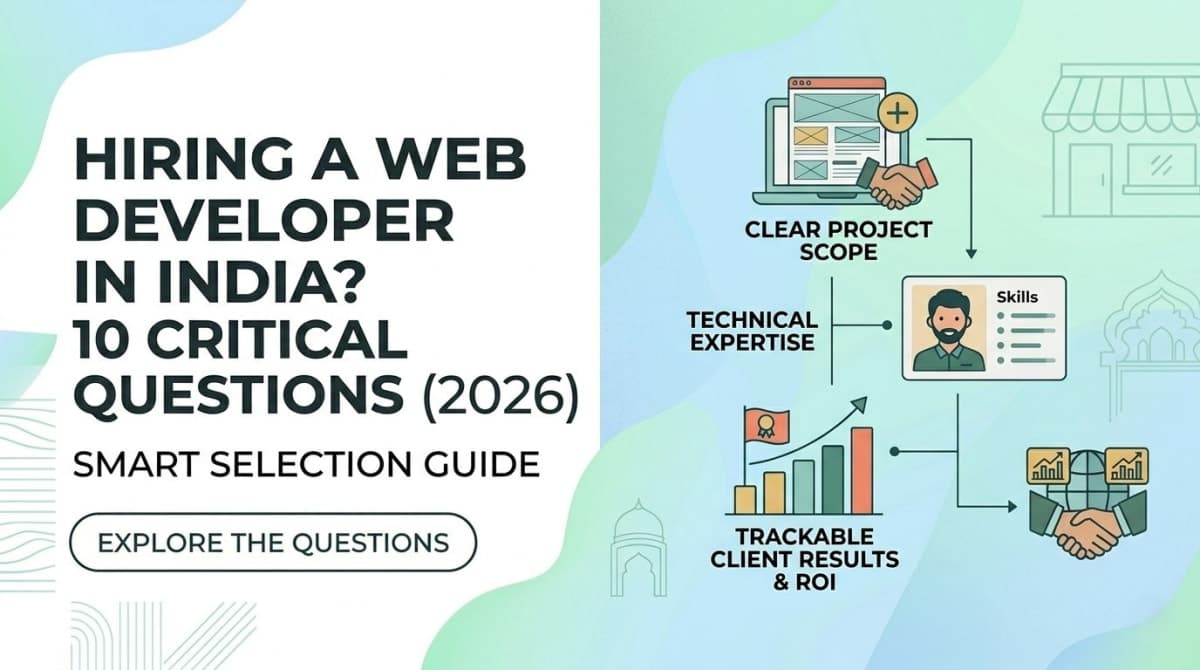
10 Questions Before Hiring a Web Developer in India (2026)
Have you ever paid for a website and got a slow, template-looking result with zero Google visibility - and the developer disappeared after delivery? This happens daily in India because the wrong questions were never asked.
Relevant next step
Want this applied to your business website?
Read the guide, then use the closest service page or send your details for a practical website direction.
Free website check
Curious if your website passes the basics?
Run a free instant check for SEO basics, CTA clarity, mobile viewport, WhatsApp path, schema, and internal links.
Signs your website is not converting
Visitors don’t take action
People read but don’t call, message, or book anything.
No clear next step
Visitors are confused about what to do after reading your site.
Too much text, low clarity
Your message is not clear in the first few seconds.
Weak trust signals
No proof, testimonials, or credibility to build confidence.
Why a website matters for local businesses
Have you ever paid for a website and got a slow, template-looking result with zero Google visibility - and the developer disappeared after delivery? This happens daily in India because the wrong questions were never asked.
The Indian web development market has hundreds of thousands of developers - from fresh graduates offering INR 3,000 websites to senior engineers with decade-long portfolios. The quality gap is enormous.
Question 1: Can You Show Me 3 Live Websites You've Built in the...
This is the most important question. Not portfolio screenshots - live URLs you can visit right now.
Visit each one on your mobile phone. Check: does it load in under 3 seconds? Does it look professional? Is it easy to navigate? Does it work on a small screen?
A developer who can't show you live work is either inexperienced or showing you work that's no longer live (often because the client was unhappy and took the site down). Three live examples is a minimum reasonable requirement.
Contextual Next Step
Reading about Hire Web Developer In India Checklist?
The next useful step is to review the right service or review page.
Question 2: Who Will Actually Build My Website?
This question exposes agencies that outsource to cheaper developers or assign your project to their most junior team member.
If you're talking to a solo freelancer, the answer is simple: they do. If you're talking to an agency, ask specifically: who is the developer assigned to my project? Can I speak with them? What is their experience level?
The person who understands your requirements should be the same person building your website. Every layer of translation between you and the developer introduces misunderstandings.
Before vs after the right website structure
Before
- Unclear homepage message
- No visible doctor or business trust
- No appointment or WhatsApp path
- Visitors leave without contacting
After
- Clear service and specialisation
- Trust section visible in seconds
- WhatsApp or call button on every page
- More enquiries from the same traffic
Don’t guess what your website needs
Understand what your website actually needs before you spend more money.
Direct team. Clear next step.
Website pricing bands to compare before hiring
Starter enquiry website
INR 18,900 - INR 30,000
- 5-7 pages website
- Mobile responsive
- Basic SEO setup
Growth website
INR 30,000 - INR 56,000
- 8-12 pages website
- WhatsApp integration
- Advanced SEO setup
Advanced website system
INR 56,000 - INR 2,00,000+
- Custom design & features
- Booking / enquiry system
- Ongoing support
Question 3: What Technology Will You Use and Why?
You don't need to understand the technical answer in detail - but a good developer will explain their choice clearly and in plain language.
Acceptable answers: "I'll use WordPress because it's easy for you to update content yourself and fits your budget." Or: "I'll use Next.js because you need a fast website that ranks well on Google and handles high traffic."
Red flag answer: "We use the latest technologies" without specifics. Or: "Whatever you want." A developer who doesn't have a considered technology recommendation for your project hasn't thought about your project.
Question 4: Who Owns the Domain, Hosting, and Code After Delivery?
You should own all three, always. No exceptions.
Domain: Registered in your name, with your email as account owner. Not the developer's account.
Hosting: Either in your own hosting account, or on a server you pay for directly. Not a "managed" setup where the developer can take your site down if you stop paying them.
Code: All source files handed over to you on project completion. You should be able to give the code to any other developer to modify.
Any developer who hesitates on any of these three points is creating dependency. Walk away.
Question 5: What Is the Complete Cost Including Domain, Hosting,...
Get the total year-one cost in writing, not just the development fee. Ask specifically:
- Is domain included? For how long?
- Is hosting included? For how long, and what's the renewal cost?
- Is SSL included? Is it free Let's Encrypt or a paid certificate?
- Are there any monthly fees after delivery?
- What's the cost for content updates after the project?
A trustworthy developer answers all of these clearly. Vague answers about "we'll discuss later" should raise concern.
Question 6: How Long Will It Take, and What Are the Milestones?
Get a realistic timeline with milestone dates, not just a final delivery date. A standard 5-page business website should take 10-21 working days.
Also ask: what information do you need from me, and when? The most common cause of project delays in India is the client taking too long to provide photos, content, or approvals. A good developer will tell you exactly what they need and when, so delays stay on your side of the fence.
Question 7: What Happens if I Need Changes After Delivery?
Understand the post-delivery policy before signing. Standard practice:
- Minor revisions during development: included
- Post-delivery bug fixes (developer error): should be free
- Content updates after delivery: typically INR 500-INR 2,000 per session
- New features or pages after delivery: new quote
Some developers charge for every small change after delivery, making your website effectively locked. Clarify what "support after delivery" means concretely.
Question 8: How Will My Website Be Found on Google?
Any developer building a business website in 2026 should include basic on-page SEO as standard. Ask what specifically they do: meta titles and descriptions, proper heading structure (H1, H2, H3), image alt tags, page speed optimization, mobile responsiveness, and Google Search Console submission.
If a developer says "SEO is a separate service" and can't explain these basics, be cautious. Basic technical SEO is not an add-on - it's part of building a website correctly.
Question 9: Can I See a Demo or Staging Link Before Full Payment?
Reputable developers either share a staging link (a live preview URL) for review before final payment, or show you relevant past work as a style reference. You should never pay 100% upfront without seeing design progress.
Standard payment structure in India: 30-50% upfront to start work, remaining 50-70% on delivery and approval. Any developer demanding full payment before showing any work is a risk.
Question 10: What Is Your Review Score and Can I Contact a Past...
Ask for a Google review link or Clutch profile. Ask if you can WhatsApp a past client who had a similar project. A developer with nothing to hide welcomes this.
Reviews on Google, LinkedIn recommendations, and Clutch.co listings are more reliable than testimonials on a developer's own website (which can be fabricated). If a developer has no verifiable public reviews after more than a year of work, ask why.
Use a simple scorecard to compare quotes
Do not choose only by the lowest number or the prettiest portfolio screenshot. Put each proposal side by side and mark whether it answers these questions clearly:
| Comparison point | What a clear proposal should state |
|---|---|
| Scope | Pages, features, content responsibilities, and exclusions |
| Ownership | Who controls the domain, hosting, source files, and third-party accounts |
| Review process | What you will review, how feedback is collected, and when approval is needed |
| Launch work | Mobile testing, contact paths, and the steps required to make the site live |
| Post-launch work | What is included, what is a new request, and how future work is quoted |
If two quotes have a similar price, choose the one that makes these responsibilities easier to understand. If a proposal leaves them vague, ask for clarification before you pay.

Written by DhirajWeb Agency
Founder-led website and enquiry system guidance
DhirajWeb Agency builds fast, mobile-first websites, landing pages, and WhatsApp enquiry flows for clinics, coaching institutes, local service businesses, and growth-focused brands in India.
Recommended guides
FAQs About Hire Web Developer In India Checklist
What is a fair upfront payment for a web development project in India?
30-50% upfront is standard and fair. It covers the developer's time investment in design and setup. 100% upfront is risky unless you have a strong existing relationship with the developer. Never pay 0% upfront - it's not a serious engagement.
How do I verify a web developer's portfolio is real and not fabricated in India?
Visit every URL they provide. Check when the domain was registered (use whois.domaintools.com). Search the business name from the website to verify it's a real client. If the site has a contact page with a real business address and phone number, it's almost certainly a real project.
Should I hire a local web developer or is a remote developer fine for a business in India?
Remote works well for web development - most of my clients are in cities across India and we collaborate entirely over WhatsApp and video calls. What matters more than location is communication responsiveness: does the developer reply promptly and clearly?
What if a web developer goes quiet after taking upfront payment in India?
This is why limiting upfront payment to 30-50% matters. If communication drops off after payment, send a formal WhatsApp message stating you'll escalate to a legal notice if you don't hear back within 48 hours. Most developers respond immediately. For serious disputes, the Consumer Forum or Cyber Crime portal are options.
Is it worth paying more for an experienced web developer in India?
Almost always yes. The difference between a INR 8,000 and INR 20,000 website isn't just aesthetics - it's loading speed, security, SEO structure, and longevity. A cheap website that needs to be rebuilt in 18 months costs more total than a quality website built once.
Dhiraj Kumar
Founder, DhirajWeb Agency
I help local businesses build conversion-focused websites with clearer trust, structure, and enquiry flow.
View all guidesNext step
Audit your own website before you hire anyone
Get a fast baseline report first. If the result looks weak, you can request a manual deep review after the instant audit.
Ready to turn your website into a lead system?
I'll help you choose the right next step before you spend more.