Website Development Timeline in India: Realistic Expectations
A delivery date is useful only when the proposed scope, content readiness, approvals, accounts, testing, and launch responsibilities are clear. Similar website labels can cover very different work.
Relevant next step
Want this applied to your business website?
Read the guide, then use the closest service page or send your details for a practical website direction.
Free website check
Curious if your website passes the basics?
Run a free instant check for SEO basics, CTA clarity, mobile viewport, WhatsApp path, schema, and internal links.
Signs your website is not converting
Visitors don’t take action
People read but don’t call, message, or book anything.
No clear next step
Visitors are confused about what to do after reading your site.
Too much text, low clarity
Your message is not clear in the first few seconds.
Weak trust signals
No proof, testimonials, or credibility to build confidence.
Why a website matters for local businesses
A delivery date is useful only when the proposed scope, content readiness, approvals, accounts, testing, and launch responsibilities are clear. Similar website labels can cover very different work.
Use the approved scope and cost framework alongside a timeline, rather than relying on a universal number of days.
Realistic Website Development Timelines by Project Type in India
There is no universal delivery duration. A timeline should be agreed after discovery and should name the dependencies that can move it.
| Website type | Main timeline dependencies |
|---|---|
| Basic information site | Approved pages, content, design direction, review windows, and launch access |
| Business website with editing or blog | Editing workflow, content preparation, design review, and account setup |
| Ecommerce store | Product data, variants, media, payment and shipping accounts, testing, and operating process |
| Custom application or portal | Requirements discovery, data, roles, integrations, security, testing, and deployment ownership |
Use milestones and acceptance checks instead of treating a generic estimate as a commitment.
Contextual Next Step
Reading about Website Development Timeline In India?
The next useful step is to review the right service or review page.
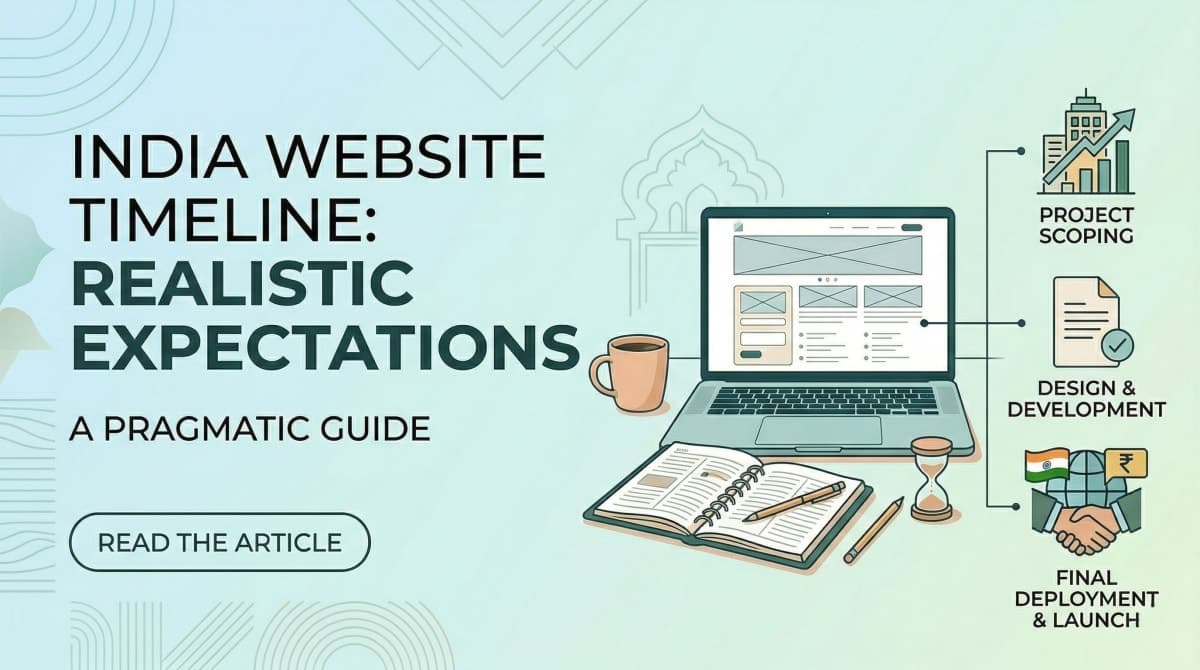
The 4 Phases of Every Website Project in India
Phase 1 - Discovery and Planning (1-3 days)
The developer understands your requirements, defines the sitemap (page list), collects reference websites you like, and sets the technology and design direction. This is also when you confirm payment terms and timeline.
Phase 2 - Design (2-7 days)
The visual design of your homepage and key pages is created. This is where you see how your website will look before any development begins. Expect 1-2 revision rounds. Approving design quickly here is the single biggest speed lever in the entire project.
Phase 3 - Development (5-15 days)
Once design is approved, development begins. Each page is coded, content is added, forms are connected, and integrations (WhatsApp, Google Maps, payment gateway) are set up.
Phase 4 - Review, Testing, and Launch (2-4 days)
You review the complete website on a staging link. Final feedback is addressed. The website is tested on mobile, tablet, and desktop. Domain is pointed and the site goes live.
Before vs after the right website structure
Before
- Unclear homepage message
- No visible doctor or business trust
- No appointment or WhatsApp path
- Visitors leave without contacting
After
- Clear service and specialisation
- Trust section visible in seconds
- WhatsApp or call button on every page
- More enquiries from the same traffic
Don’t guess what your website needs
Understand what your website actually needs before you spend more money.
Direct team. Clear next step.
Website pricing bands to compare before hiring
Starter enquiry website
INR 18,900 - INR 30,000
- 5-7 pages website
- Mobile responsive
- Basic SEO setup
Growth website
INR 30,000 - INR 56,000
- 8-12 pages website
- WhatsApp integration
- Advanced SEO setup
Advanced website system
INR 56,000 - INR 2,00,000+
- Custom design & features
- Booking / enquiry system
- Ongoing support
What needs to be agreed before a timeline is credible
A delivery date is useful only when the work and approvals behind it are clear. Before work starts, put these items in writing:
| Item to confirm | Why it protects the timeline |
|---|---|
| Page and feature scope | Prevents new requirements being treated as part of the original launch |
| Content and asset owner | Makes clear who supplies copy, photos, logo files, product details, or credentials |
| Review owner | Avoids waiting for several people to approve every change |
| Feedback window | Keeps review rounds visible instead of open-ended |
| Launch access | Ensures domain, hosting, email, analytics, or other required access is ready when needed |
This is not extra paperwork. It is the practical difference between a planned launch and a project that keeps moving without a clear next step.
Common Reasons Website Projects Move Beyond Their Initial Timeline
Delays can come from either side of a project. Make the dependencies visible rather than assigning blame. Common reasons include:
1. Content not ready: The developer is waiting for photos, service descriptions, pricing, or your logo. No content = no progress. Prepare all your content before the project starts.
2. Review availability: Agree who approves work and a practical feedback window before the project starts.
3. Scope creep: "Can we also add a chatbot, an online booking system, and a Hindi version?" after the project has started. New features mid-project extend timelines. Define your requirements completely before signing.
4. Missing credentials: Domain access, hosting login, email account details - these are often needed urgently and cause days of delay when unavailable.
5. Multiple decision-makers: Identify the review owner and escalation path so approval responsibilities remain clear.
How to Be the Best Client and Get Your Website Delivered Faster...
The clients whose projects are completed fastest all do the same things:
1. Prepare content before the project starts: Photos, logo, services list, pricing, and your business description - all ready on day one.
2. Give one-person approval authority: Designate a single person who has the final say on design and content. No committees.
3. Respond within 24 hours: Review designs, answer questions, and approve milestones the same day you receive them.
4. Define requirements completely upfront: Know what pages you want before the project starts. "I'll think about it as we go" doubles the timeline.
5. Trust the developer's judgment: Constant micro-revisions ("make the logo 2px bigger," "change this shade slightly") add hours to every iteration. Give directional feedback ("this feels too formal, I want it warmer") rather than pixel-level instructions.
Rush Projects: What to Clarify Before You Commit
A short turnaround may be possible for a narrow scope with approved content, ready access, limited review cycles, and a clear launch path. It is not appropriate to assume the same timeline for a broader website, store, portal, or integrated project.
Before accepting a rush timeline, list the pages, content, accounts, contact actions, devices, tests, approvals, and exclusions in writing. Do not skip review or testing simply to meet a date.

Written by DhirajWeb Agency
Founder-led website and enquiry system guidance
DhirajWeb Agency builds fast, mobile-first websites, landing pages, and WhatsApp enquiry flows for clinics, coaching institutes, local service businesses, and growth-focused brands in India.
Recommended guides
FAQs About Website Development Timeline In India
Can I launch a 'coming soon' page while my website is being built in India?
Yes. A simple temporary page can provide approved contact information while development continues. Confirm its content, ownership, analytics and Search Console approach, and whether it should be indexed, before publishing it.
What content do I need to provide before my website development starts in India?
Logo (PNG with transparent background), business description (5-8 sentences), services list with descriptions, pricing (or ranges), 10-20 photos of your work/products/premises, team photos, and contact details (phone, WhatsApp, email, address, hours).
What if I don't have professional photos for my website in India?
Smartphone photos taken in good natural light work for a starting website. Avoid dark, blurry, or small images. I can also use high-quality stock photos relevant to your industry as placeholders while you arrange your own photos.
How many design revisions are typically included in a web development project in India?
Revision allowance is a commercial and scope decision. Agree the review stages, what counts as a revision versus a new requirement, the approval owner, and how additional work is estimated before the project starts.
What happens after my website launches in India?
Confirm the launch checklist, account ownership, analytics or Search Console setup, handover, support period, and process for future changes in the written scope. These items vary by project and provider.
Dhiraj Kumar
Founder, DhirajWeb Agency
I help local businesses build conversion-focused websites with clearer trust, structure, and enquiry flow.
View all guidesNext step
Audit your own website before you hire anyone
Get a fast baseline report first. If the result looks weak, you can request a manual deep review after the instant audit.
Ready to turn your website into a lead system?
I'll help you choose the right next step before you spend more.