Local business guide
Business Website Checklist: 5 Pages That Generate Enquiries
Your developer is asking what pages you want - and you're staring at a blank document. Get this wrong and you'll have a beautiful website that generates zero enquiries.
Your developer is asking what pages you want - and you're staring at a blank document. Get this wrong and you'll have a beautiful website that generates zero enquiries.
People read but don’t call, message, or book anything.
Visitors are confused about what to do after reading your site.
Your message is not clear in the first few seconds.
No proof, testimonials, or credibility to build confidence.
Your developer is asking what pages you want - and you're staring at a blank document. Get this wrong and you'll have a beautiful website that generates zero enquiries.
Most Indian business websites are missing 2-3 critical elements that directly determine whether visitors call you or leave. Understanding the real costs of a properly built business website helps you plan the right scope for your needs.
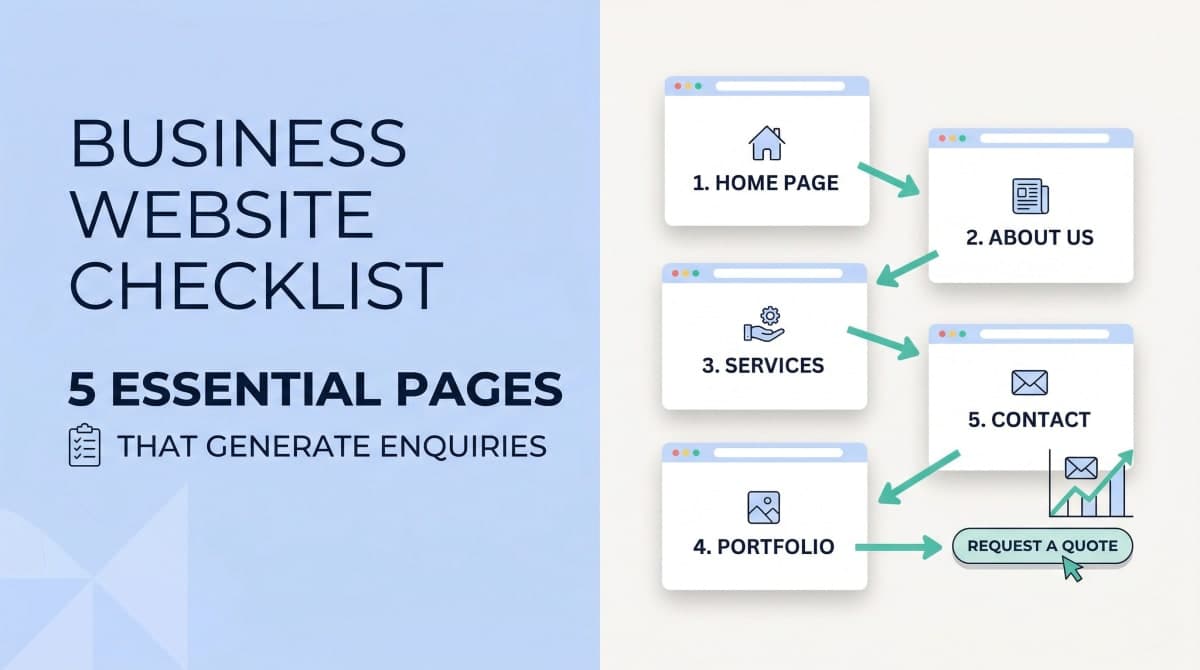
1. Home Page: Your first impression. It must answer three questions in under 5 seconds: Who are you? What do you do? Who is it for? Your most important service, a clear headline, and a prominent call-to-action (WhatsApp button or phone number) above the fold.
2. Services / Products Page: Detail every service or product you offer. Be specific. Include: what the service includes, who it's for, approximate pricing or starting price, and how to get started. Vague services pages ("We offer comprehensive digital solutions") convert nobody.
3. About Page: Your story, your team, your credentials, and why you're the right choice. The About page is consistently one of the 3 most-visited pages on any business website. Write it as if you're speaking to one specific potential customer.
4. Contact Page: Phone number (clickable to call), WhatsApp button (direct link), email, full address, and Google Maps embed. Operating hours. Multiple contact methods. Make it impossible to not find how to reach you.
5. Gallery or Portfolio Page: Photos of your work, products, premises, or team. Visual proof that you're real and capable. For service businesses, before/after photos or project photos are your strongest trust signals.
Contextual Next Step
If this topic matters for your business, the next useful page is usually the main landing page for that intent. That gives you the service structure, proof path, and pricing context directly instead of leaving everything inside blog content alone.
Trust is the gap between a visitor and an enquiry. These elements close that gap:
Customer Testimonials: 3-5 real quotes from real customers with their name and business/city. Photo testimonials convert 30% better than text-only.
Google Review Rating: Embed your Google rating (visible stars) on your homepage. If you have 4.5+ stars and 20+ reviews, display this prominently.
Credentials and Certifications: Degrees (doctors, CAs), certifications (ISO, FSSAI), registrations (RERA, GST number). Display the logos and registration numbers.
Years in Business and Projects Completed: "7 years in business" and "200+ websites delivered" are simple numbers that build significant credibility.
Team Photos: Real photos of real people. Stock photo team photos are immediately recognized and destroy trust. A genuine photo of you at work or your team together is worth more than any marketing copy.
Before
After
Understand what your website actually needs before you spend more money.
Direct team. Clear next step.
After auditing hundreds of Indian business websites, these are the most commonly missing elements that directly hurt conversion:
Clear budget range: "Contact for pricing" loses serious prospects. Even a simple starting range helps people decide faster.
Clickable phone number: Displaying a phone number as plain text instead of a tel: link forces mobile users to manually dial. Costs you calls every day.
WhatsApp button: India's business communication runs on WhatsApp. Every business website should have a floating WhatsApp button visible on every page.
FAQ section: Answering the 5 most common questions your customers ask saves you time on calls and builds trust with visitors who won't ask the question directly.
Last updated date or recent activity: An "About Us" page that says "Founded in 2010" with no other dates signals the website might be abandoned. Show recent testimonials, recent project dates, or a recently updated blog.
This is where most projects stall. Your developer needs this content from you before they can complete your website:
1. Logo file (PNG with transparent background preferred)
2. Profile/team photos (high resolution, well-lit)
3. Photos of your work, products, or premises (minimum 10, maximum the better)
4. Services list with descriptions and prices
5. Your business story (3-5 sentences about background and why you do this)
6. 3-5 customer testimonials (name, quote, city/company)
7. Contact details (phone, WhatsApp, email, address, business hours)
8. Google Maps link for your location
The faster you provide this, the faster your website is delivered. Most project delays are content delays, not development delays.
All the right pages and trust signals matter. But the single element that determines whether your website generates leads is this: one clear, prominent call to action on every page.
Every page should end with an answer to the question: "What should I do now?" For most Indian businesses, that's one of: "Call us," "WhatsApp us," or "Get a free quote."
Don't offer too many options. Don't bury the CTA at the bottom. Make it impossible to miss. A beautiful website with no clear CTA is a brochure. A simple website with a clear CTA is a sales tool.
5-8 pages is the sweet spot for most Indian small businesses: Home, Services, About, Portfolio/Gallery, Blog (optional but recommended), and Contact. More pages aren't better - better content on fewer pages beats thin content spread across 20 pages.
Not immediately. A blog is valuable for SEO and establishing expertise, but only if you'll actually publish regularly (at least once a month). An empty blog with no posts or posts from 3 years ago signals neglect. Add a blog when you're ready to commit to it.
Yes, or at minimum show price ranges. Businesses that show pricing get fewer but better-qualified enquiries. Businesses that hide pricing waste time qualifying callers who can't afford them. Transparent pricing is a trust signal in India.
Yes, if your website collects any personal data (contact forms, email signups, cookies). A privacy policy is legally required under India's PDPB (Personal Data Protection Bill) and is required by Google Ads and most email marketing platforms.
For most Indian small businesses targeting local customers, English with Hindi CTAs (like WhatsApp buttons) works well. If your primary audience speaks only Hindi (many tier-2/3 city small businesses), a Hindi-primary or bilingual website is more effective and easier to rank for Hindi keywords.

Website Developer for Local Service Businesses
I help clinics, salons, and service businesses get more enquiries using simple, conversion-focused websites.
View all guidesI’ll guide you on the right structure before you spend more money.

Guides
INR 18,900
INR 56,000+