Boutique agency planning
Strategy, copy, UX, and build direction stay aligned from the first review.
Loading page…
For agents, builders, and property consultants
DhirajWeb Agency builds clear, mobile-first real estate websites for agents, builders, and property consultants in India. The website is planned to showcase projects clearly, build buyer trust faster, and create a simpler path to site-visit enquiries, WhatsApp leads, and form submissions.
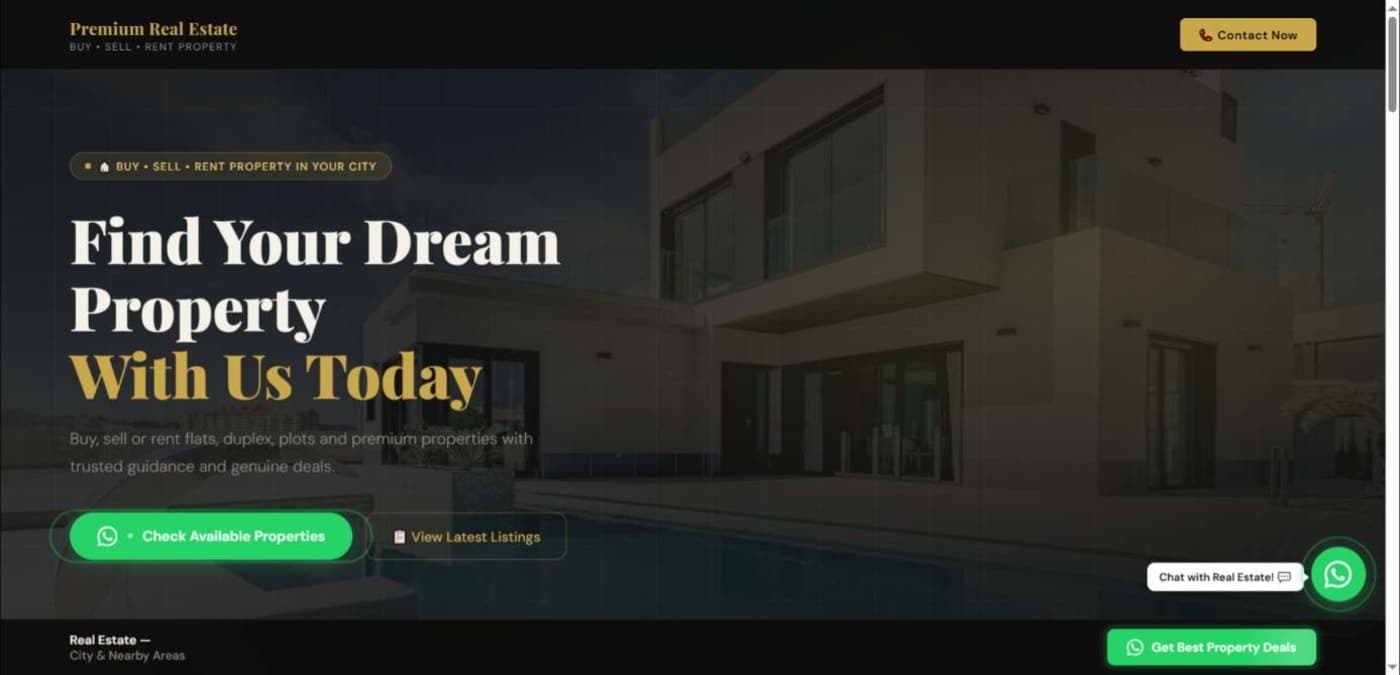
Urban Nest
Project enquiry flow
Project pages, locality trust, and WhatsApp leads.
Strategy, copy, UX, and build direction stay aligned from the first review.
Dhiraj reviews the structure, offer clarity, and enquiry path before launch.
Landing pages, Meta Ads, creatives, and WhatsApp flows can be layered when needed.
Proof from real campaign work
A practical proof asset for how DhirajWeb connects website direction, creative messaging, and Meta Ads with enquiry flow.
98
WhatsApp enquiry starts
INR 17.08
Avg. enquiry cost
45,649
Campaign reach
A lot of property websites show listings but still fail to convert visitors into enquiries. The main issue is usually not only traffic. It is weak trust-building, poor project clarity, and no smooth path to WhatsApp or site-visit action.
Project information is unclear or incomplete.
The website does not build trust quickly enough.
Locality intent is not structured well for search.
Enquiry forms and WhatsApp actions are not strong enough.
Channel decision
A listing portal and a business website solve different parts of the journey. Choose the destination around the project information and response path you can keep accurate.
Useful when the immediate need is wider listing discovery. Keep project details and the contact owner accurate there.
Useful when buyers need fuller project context, locality detail, approved media, and a direct site-visit or brochure enquiry path.
Useful when a portal supports discovery and the website gives serious buyers a clearer place to compare approved project details before contact.
A real estate website should make project pages, locality SEO, and enquiry flow visible enough for serious buyers to take action.
Project pages with clear details and images.
Locality or area pages for search relevance.
WhatsApp-first or form-first lead capture.
Trust sections like developer info, FAQs, and proof.
Mobile-first structure for high-intent buyers.
Real estate visitors compare project confidence, locality fit, and the ease of booking a site visit before they call or message.
Buyers need location, pricing direction, amenities, possession status, and clear project photos before they take a site-visit step.
Area pages, nearby landmarks, connectivity, and buyer-use cases help visitors decide whether the property matches their intent.
A strong real estate website makes brochure requests, WhatsApp questions, calls, and site-visit enquiries easy on mobile.
A real estate website can only make an enquiry path clearer when project information and the business response process are ready behind it.
Prepare the project name, location, configuration, amenities, images, and any buyer information that the business is ready to publish accurately.
Decide who replies to calls, WhatsApp messages, brochure requests, and site-visit questions before the website sends traffic to them.
Keep property-specific claims, availability, pricing direction, and required disclosures under the business’s own review before publication.
Property consultants.
Real estate agents and brokers.
Builders and developers.
Real estate businesses needing project-based enquiry flow.
Starter real estate websites usually fit INR 18,900 - INR 30,000, serious project or broker websites usually fit INR 30,000 - INR 56,000, and advanced multi-project systems can move into INR 56,000 - INR 2,00,000+. Simpler websites stay lower, while businesses that need multiple project types, stronger area targeting, or deeper lead flow move higher.
Understand the business, projects, and enquiry goal.
Structure pages around buyer trust and next-step actions.
Build a mobile-first website with strong enquiry flow.
Launch and refine around real lead behaviour.
A strong real estate website should include project pages, locality or area pages, enquiry forms, WhatsApp lead flow, and trust-building sections that help buyers move toward contact or site visits.
Yes. The website can be structured around area or locality intent so that project and property pages are easier to understand and more relevant for search.
Starter real estate websites usually fit INR 18,900 - INR 30,000, serious project or broker websites usually fit INR 30,000 - INR 56,000, and advanced multi-project systems can move into INR 56,000 - INR 2,00,000+.
No. It is suitable for agents, builders, brokers, and property consultants who need stronger online enquiries.
Because buyers often compare multiple projects and need trust, location clarity, and an easy next step before they enquire.
Send your business type, current website if you have one, and what kind of property enquiries you want more of. I will suggest the likely scope, what should be fixed first, and whether you need a fresh build or a more focused improvement plan.